5 Synergistic Herb Combinations: Why These Herbs Work Better Together
Five field-tested herb pairings — and why combining herbs deliberately often works better than taking them one at a time.

The most common herb mistake has nothing to do with picking the wrong plant. Most people pick perfectly good herbs. They just take them one at a time, the way you would take a vitamin, and then wonder why so little seems to happen.
Turmeric is the one this happens with most. Someone reads that it calms inflammation, buys a jar of the powder, stirs a spoonful into warm water every morning, and feels almost nothing. A few weeks later they are a little annoyed, wondering whether turmeric was oversold.
“I gave turmeric a fair shot for my knees. Three months, every morning, a heaping teaspoon stirred into warm water. I felt nothing. I was ready to write it off as another supplement that sounds better than it works.”
— Barbara, reader email
It was not oversold. It was just being taken in a way that throws most of it away. On its own, the curcumin in turmeric (the compound doing the real work) slips through your gut almost unabsorbed. Pair it with one ordinary ingredient from your spice rack and that changes completely. That single fix is the heart of herbal synergy, and once it clicks, taking herbs one at a time stops making much sense.
What herbal synergy actually means
Synergy is a real, measurable effect, not a vague idea. It means two or more herbs taken together do something that neither one does as well on its own. Sometimes that is about absorption, where one herb helps your body take in another. Other times one herb softens a rough edge so you tolerate the second more easily, the way ginger can settle the stomach upset a stronger herb might cause. The most useful pairings are the ones where two plants press on the same problem by separate routes, so the combined result is bigger than what you would get by adding them up.
Turmeric and black pepper is the clearest example. Curcumin, the active part of turmeric, is poorly absorbed on its own. Black pepper contains a compound called piperine, and piperine slows the gut and liver enzymes that would normally break curcumin down before it ever reaches your blood. Add a pinch of pepper to your turmeric and absorption climbs sharply, by as much as 2000% in the research.1
Up to 2000% increased curcumin absorption (Shoba et al., 1998)
Five synergistic herb combinations worth knowing
Below are five of the most reliable herb combinations, grouped by what they help. None of them are exotic. You can find every plant here at a decent grocery store or herb shop, which is rather the point. A good pairing should be within reach.
Turmeric and black pepper, for inflammation
This is a good pair to start with, because the change is so easy to feel. The black pepper lets the turmeric actually reach your bloodstream, and curcumin absorbs better alongside a little fat too, so plain water is not the best way to take it. It is a natural fit for the everyday stiffness that builds up in aging joints, and for the soreness that settles in a day or two after hard physical work. The most pleasant way to get all of it at once is golden milk, which folds ginger into the mix and turns a fussy supplement into something you look forward to at the end of the day. Make it a habit rather than a rescue, since turmeric does its best work when it stays in your system steadily over weeks.
Golden Milk
Yields 2 cups
Ingredients
- 2 cups milk (dairy or unsweetened plant milk)
- 1 teaspoon ground turmeric
- 1/4 teaspoon ground black pepper
- 1/2 teaspoon ground ginger
- 1 teaspoon coconut oil or ghee
- 1/4 teaspoon ground cinnamon (optional)
- Honey or maple syrup to taste
Instructions
- Warm the milk in a small pot over low heat. Do not let it boil.
- Whisk in the turmeric, black pepper, ginger, and cinnamon until the powders dissolve.
- Add the coconut oil or ghee and let everything simmer gently for 5 minutes, stirring now and then.
- Take the pot off the heat, stir in honey to taste, and drink it warm.
Echinacea and elderberry, for immune support
Echinacea and elderberry pair well because they cover different stages of catching something. Echinacea prompts your immune system to respond faster, which is why timing is everything with it. The moment you feel that first scratch at the back of your throat is when it earns its place, not three days into a full cold. A 2007 meta-analysis in The Lancet Infectious Diseases looked at fourteen trials and found echinacea cut the chance of catching a cold by more than half and shortened a cold by about a day and a half when it was started early.2 Elderberry brings a heavy load of dark pigment compounds called anthocyanins, and the most cited study on it found that flu symptoms cleared on average four days sooner in people who took it.3 Taken together at the very first sign, they give you a quick immune push and antiviral support in the same dose. A bottle of elderberry syrup with an echinacea tincture stirred in is an easy way to keep both on hand for the season, and it is gentle enough to make a lighter version for the kids in the house too.
A faster immune response paired with antiviral support, taken at the first sign of a cold
Ashwagandha and holy basil, for stress
Of all the ashwagandha pairings, this is the one to know first. Both herbs are adaptogens, a word that simply means they help your body hold steady under stress, and they approach it from opposite ends. Ashwagandha tends to take the edge off a wired, racing feeling, and it has good research behind its effect on cortisol, the hormone your body floods you with when you are under pressure. In a sixty-day trial, people taking a standardised ashwagandha extract saw their cortisol drop by around 28%, compared to roughly 8% on placebo.4 Holy basil, which you will also see called tulsi, lifts a flat or foggy mood and carries you through a long, draining day, with the added benefit of helping steady blood sugar. A six-week trial of a tulsi leaf extract found a clear drop in stress symptoms compared to placebo across all three of the categories the researchers tracked.5 An easy way to use both is tulsi tea in the afternoon when energy dips, then ashwagandha in the evening, where its calming effect lines up neatly with getting ready for sleep.
Chamomile, lemon balm, and passionflower, for sleep
For sleep, a single herb rarely does the job, because people lie awake for different reasons and each plant answers a different one. Chamomile carries a compound called apigenin that quietly settles the nervous system. For the tension that sits in your shoulders and your stomach, lemon balm helps, and it has held up well in small trials for both anxiety and sleep quality.6 Passionflower is the one for when the real trouble is a mind that will not stop narrating the day. A short, well-designed Australian study had people drink a cup of passionflower tea before bed for a week and reported a clear improvement in sleep quality versus placebo.7 Brewed together about forty-five minutes before bed, the three make one of the steadiest sleep blends around, and none of them leave you with the morning fog that a sleeping pill so often does.
Bedtime Tea
Yields 1 cup
Ingredients
- 1 teaspoon dried chamomile flowers
- 1 teaspoon dried lemon balm
- 1/2 teaspoon dried passionflower
- 8 ounces just-boiled water
- Honey to taste (optional)
Instructions
- Combine the dried herbs in a mug or a tea infuser.
- Pour the just-boiled water over them and cover the mug so the steam stays in.
- Steep for 10 minutes, then strain out the herbs.
- Stir in honey if you like, and sip it 30 to 45 minutes before bed.
Ginger and turmeric, for digestion and inflammation
Ginger and turmeric are close relatives, two knobby roots from the same plant family, and they cover for each other beautifully. Turmeric works on inflammation through curcumin, while ginger brings its own anti-inflammatory compounds called gingerols and, on top of that, calms a queasy stomach. A landmark trial in Arthritis & Rheumatism found that a concentrated ginger extract eased knee pain about as well as a typical dose of ibuprofen, with fewer of the stomach side effects.8 So one pairing gives you broad relief from inflammation and real digestive comfort at the same time. It is the duo for when achy, stiff joints come bundled with a sensitive gut, which is a more common pair of complaints than you might expect. It is also the reason ginger is sitting right there in the golden milk further up the page.
When a combination works against you
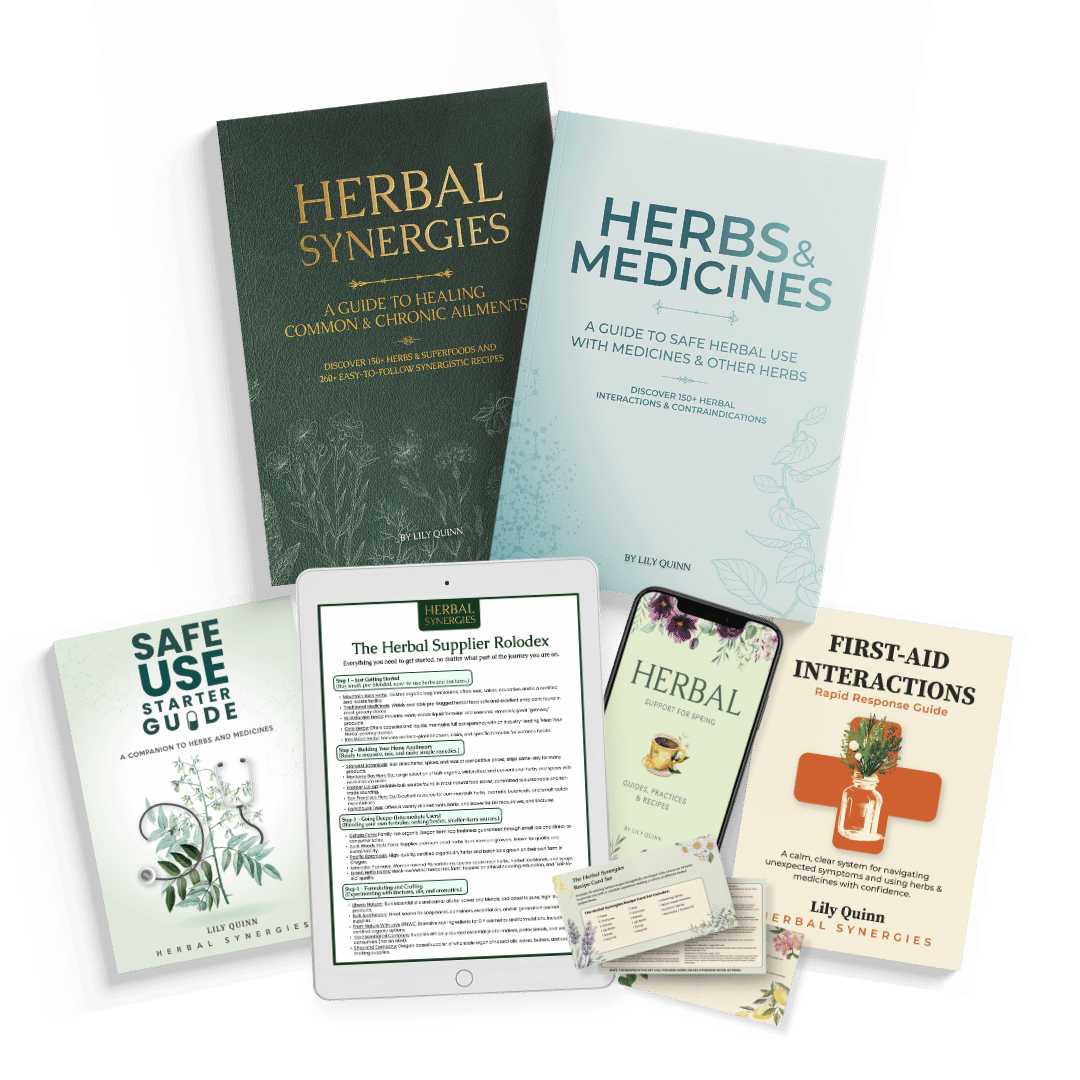
Here is the other half of the skill, and it matters every bit as much. The same chemistry that lets two herbs strengthen each other can also make them clash, either with one another or with a prescription you already take. St. John’s Wort is the big one to know. Taken alongside an SSRI antidepressant it can push serotonin too high and set off a genuinely dangerous reaction, and on its own it weakens a long list of medications by speeding up how fast your body clears them. Synergy and interaction are the same knowledge pointed in opposite directions, which is exactly why Herbs & Medicines exists as a companion to this guide.
How to start pairing herbs at home
If pairing herbs is new to you, begin with one combination instead of five. Choose a single pair that matches something you actually want help with, the golden milk for achy joints, say, or the bedtime tea for restless nights, and give it two to three weeks. Keep it almost boringly consistent: same time of day, same amount, and write it down somewhere so you are not trusting your memory. The pairings that earn a permanent place in a routine are almost always the ones tracked closely enough to be sure of.
Then pay attention to what your body tells you. Notice how you sleep, how your digestion feels, and whether your energy holds through the afternoon. Your own response is better information than any chart could give you. Once a pairing has clearly earned its place, add the next one. Going slowly is not a limitation here, it is the whole method.
These are not random pairings; they are tested. Herbal Synergies documents 100+ of them, organized by what they help.
References
- Shoba G, Joy D, Joseph T, Majeed M, Rajendran R, Srinivas PS. Influence of piperine on the pharmacokinetics of curcumin in animals and human volunteers. Planta Med. 1998;64(4):353–356. PubMed
- Shah SA, Sander S, White CM, Rinaldi M, Coleman CI. Evaluation of echinacea for the prevention and treatment of the common cold: a meta-analysis. Lancet Infect Dis. 2007;7(7):473–480. PubMed
- Zakay-Rones Z, Thom E, Wollan T, Wadstein J. Randomized study of the efficacy and safety of oral elderberry extract in the treatment of influenza A and B virus infections. J Int Med Res. 2004;32(2):132–140. PubMed
- Chandrasekhar K, Kapoor J, Anishetty S. A prospective, randomized double-blind, placebo-controlled study of safety and efficacy of a high-concentration full-spectrum extract of ashwagandha root in reducing stress and anxiety in adults. Indian J Psychol Med. 2012;34(3):255–262. PubMed
- Saxena RC, Singh R, Kumar P, et al. Efficacy of an extract of Ocimum tenuiflorum (OciBest) in the management of general stress: a double-blind, placebo-controlled study. Evid Based Complement Alternat Med. 2012;2012:894509. PubMed
- Cases J, Ibarra A, Feuillère N, Roller M, Sukkar SG. Pilot trial of Melissa officinalis L. leaf extract in the treatment of volunteers suffering from mild-to-moderate anxiety disorders and sleep disturbances. Mediterr J Nutr Metab. 2011;4(3):211–218. PubMed
- Ngan A, Conduit R. A double-blind, placebo-controlled investigation of the effects of Passiflora incarnata (passionflower) herbal tea on subjective sleep quality. Phytother Res. 2011;25(8):1153–1159. PubMed
- Altman RD, Marcussen KC. Effects of a ginger extract on knee pain in patients with osteoarthritis. Arthritis Rheum. 2001;44(11):2531–2538. PubMed
This article is educational and is not a substitute for individualized medical or medication guidance from your physician, pharmacist, or other healthcare professional. Herbs can interact with medications and with each other; always confirm anything new with your provider. These statements have not been evaluated by the Food and Drug Administration.
How we research and review
Guides in the Herbal Reference Library draw on the same reference system as our books, which point to more than 500 scientific citations readers can check for themselves. Every recommendation is framed as support for everyday wellness, never as a treatment or a cure, and safety notes direct readers to confirm combinations with their own healthcare professional.
The Herbal Synergies Research Team compiles and reviews every guide in the Herbal Reference Library, drawing on published research, recognized herbal monographs, and current medication references. Our guides are written to support everyday wellness and always point you back to a qualified healthcare professional before you combine anything new.